What is Early Math Really?
Early math is talked about often, but unfortunately the fundamental understanding of what early math actually is can be lost very… well, early. Early math consists of both procedural math and conceptual math. Procedural math generally begins in preschool and kindergarten and consists of a series of steps in order to solve a problem. For younger ages, this means basic addition and subtraction, using a tool (say a ruler) to measure an object, or counting sides of a shape and knowing the name of that shape because of it. This is the foundation of procedural math that later leads to, say, College Algebra or Calculus proofs.
On the other hand, the conceptual side of early math explains why the algorithm or procedure works. And this is what makes early math complex and not tied to specifically what happens in the early grades in the form of memorization charts or worksheets.
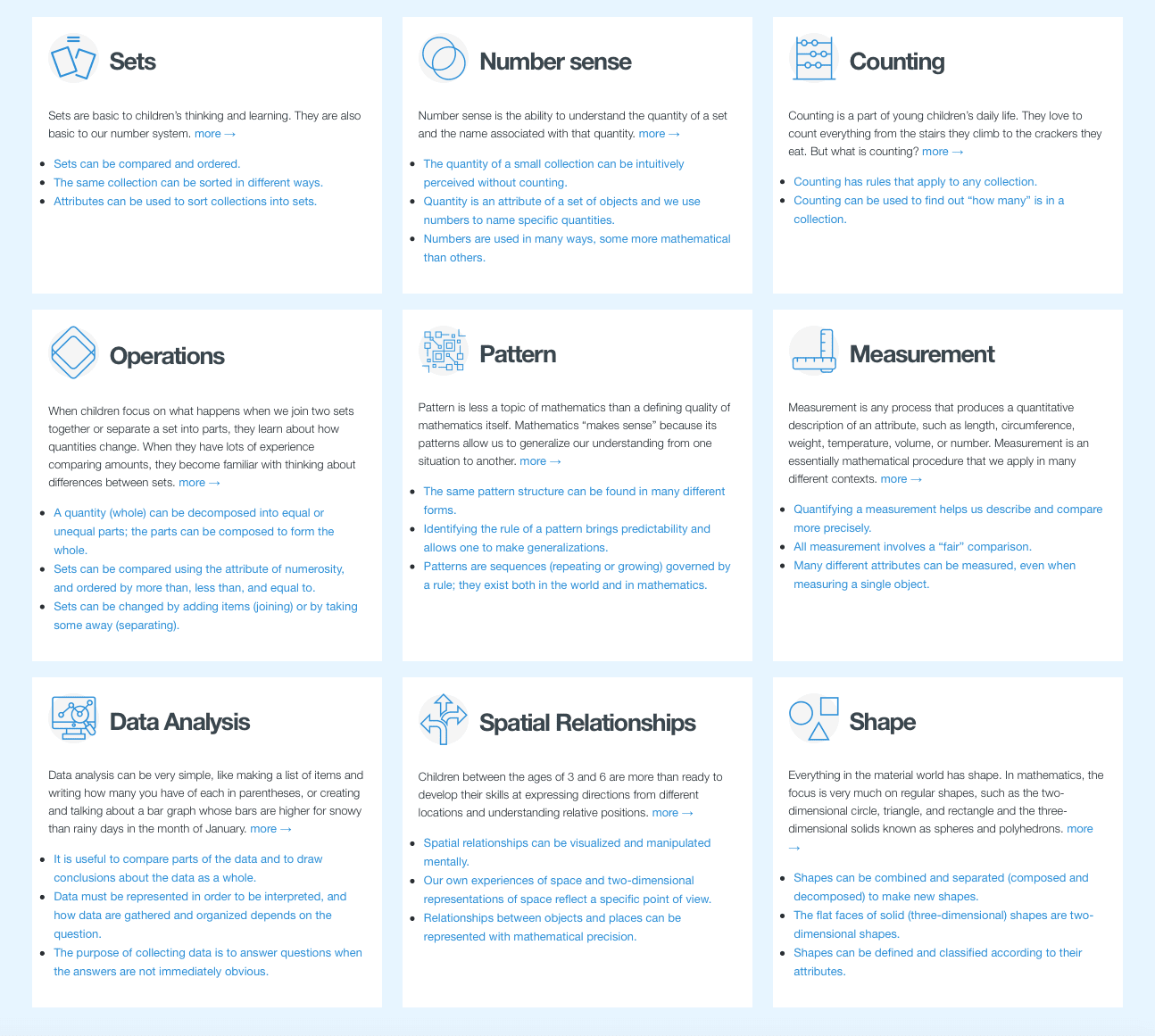 In the middle of what we deem “early math” there consists a broad range of topics that have traditionally been taught starting in preschool and kindergarten, such as counting, measurement, shapes, pattern, and number sense.
Although there are procedures and facts involved in learning within each of these early math topics, conceptual learning of each of them leads to deeper understanding that has greater long term impact. For example, a procedural solution to a simple two digit subtraction problem (32-28) involves the traditional act of “borrowing” so that a 1 can be borrowed from the ten’s place to make 12 minus 8, or 4. Conceptual understanding of that subtraction problem explains how that procedure works and allows children to check the answer with logical thinking. The Big Idea that larger numbers are composed of smaller numbers allows a child to break those two numbers into smaller numbers (10 + 10 + 10 + 2) and (10 + 10 + 8). This may allow them to take two 10s from each side, leaving a simpler 12-8 equation. Why does this help? Besides confirming the answer through two different means (always a good thing when solving a problem) it also lays the groundwork for more complicated problem solving, such as long division.
Understanding both the procedural and conceptual helps not only in tackling learning in preschool and kindergarten, which is squarely in the middle of the “early years,” but it is also important to the earlier part of early math. Conceptual math in the early years begins in infancy. Yes, babies and toddlers. It begins with innate mathematical capacities such as attribute, comparison, pattern, and change. These precursor concepts don’t rely on symbols or understanding of number words, which comes later. It is understanding of the world around them. If a child doesn’t have basic understanding about comparison, the idea of equality and the equal sign can become difficult when it begins to be used in calculations and algorithms in a later math class. If an understanding of attribute isn’t fleshed out in a child’s mind, later when they are comparing a group (2a) to a different group (3b), the idea that a and b are in different groups because they have different attributes may not click.




Support our work
The Early Math Collaborative works to improve math instruction for young children in three ways:
- Professional development
- Research
- Dissemination