Research
Teacher Development
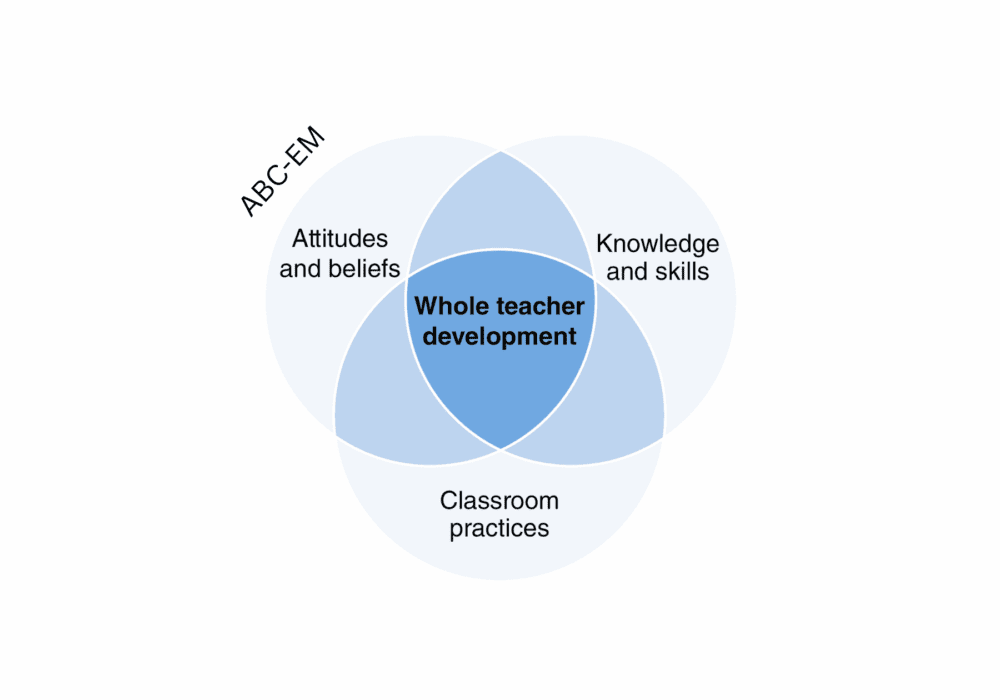
To study these questions, we refer to the Whole Teacher Approach, a framework we use to design our professional development (PD). Just as the Whole Child Approach–familiar to many in the early childhood field–directs teachers’ energy toward not only children’s cognitive development but also their social/emotional and physical development, the Whole Teacher Approach urges broader, wholistic attention given to teachers as part of PD.
Whole Teacher Approach
We parse this construct as teachers’ knowledge, attitudes, and practices related to early math and use these elements to guide the design and implementation of our educational efforts. That is, our PD is explicitly designed to address not only teachers’ knowledge, but also teachers’ attitudes about math and math teaching and their math teaching practice.
In an effort to understand how and whether our PD is working, we assess changes in these three factors among early childhood teachers. Because early math education is still a relatively under-studied topic, there is a paucity of research tools designed to study how teachers develop. There are several good tools for studying math teachers and teaching at the elementary school level, but early mathematics is so different that much of what these tools assess does not apply well in a preschool or even kindergarten classroom. Further, we are also working with caregivers of infants and toddlers to improve their understanding of the thinking and learning that precedes mathematics among young children. Elementary-level assessments of teachers’ development are not adequate for understanding shifts among teachers that are relevant to teaching our youngest children. For this reason, we are developing our own tools.
Attitudes
To assess attitudes, we employ the Attitudes, Beliefs, and Confidence Survey, or ABC. The tool was designed to provide information about how teachers feel about mathematics in general and how confident they feel about their own teaching of early mathematics. Teachers respond to statements using a likert scale to help us assess these factors. We developed three versions of the ABC for use with PK-3 teachers (ABC-EM), PK teachers (ABC-PM), and birth-3 teachers (ABC-0to3).
Knowledge
Our current work to develop a measure of teacher knowledge entails adapting a semi-structured interview protocol, the Preschool Math Pedagogical Content Knowledge, into an online survey to be taken by preschool teacher. This online tool presents a play-based scenario in an early childhood classroom and asks teachers what opportunities it presents for the children to think mathematically. We also are piloting a semi-structured interview protocol to assess the capability of birth to 3 teachers to detect moments to facilitate interactions around pre-cursor mathematical concepts in young childrens’ routines and play.
Practice
Our measure of early math teaching practice, Evaluating Quality Interactions in Preschool Mathematics (EQUIP-M), is a video-based, observation tool focused on evaluating the quality of interactions during a short episode of intentional early math teaching. Specifically, we look at interactions between teachers and students to ascertain a teachers’ intentionality in planning and implementing a math activity, the teacher’s responsiveness to students, and students’ productive engagement in math learning.
We also study implementation and effectiveness of our PD efforts more directly. Through our current NSF grant, Collaborative Math: Creating Sustainable Excellence in Mathematics for Head Start Programs (DRK-12 1503486) we are testing the promise and sustainability of a PD model for working with Head Start centers. The goal of this year-long, whole-center intensive, PD program is to develop instructional leaders and support teaching staff in creating and maintaining centers of excellence for early math teaching. Our evaluation efforts focus on documenting fidelity of implementation of program components and investigating the impact of participation of in Collaborative Math on instructional leader, teacher, and child outcomes.

Our mission
We are transforming the understanding, teaching and learning of early mathematics from the ground up. Explore the Core Values that guide us in our mission-driven work.

We publish our research in practitioner and scholarly journals and present at local and national conferences. Our current work, as well as papers accompanying presentations, is shared through our Working Paper series.

We present at local and national conferences every year. We seek to further the discussion surrounding practice and assessments that influence the teaching and learning of mathematics in the early years.

Join the Collaborative
Together, We Can Change the Way Math Is Taught
Join a hub of educators, administrators, and professionals reframing the way we think about and teach math.