The Five Principles of Anji Play
In March, I spent two days in Anji, China, learning about its internationally admired approach to children’s play. I visited two kindergartens, observed outdoor play, sat in on a play-sharing session, and spoke with teachers, center directors, and Ms. Cheng Xueqin, the visionary behind Anji Play.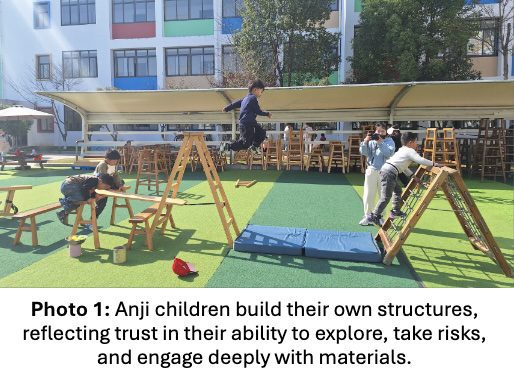
Anji is a lush, rural county three hours from Shanghai. With 130 public kindergartens serving 14,000 children ages 3 to 6, nearly all young children in Anji—an impressive 99 percent—attend public programs.
I’ve followed Anji Play for nearly two decades but seeing it in action made all the difference. The experience brought my new understanding to MIT professor Mitchel Resnick’s words: “Anji Play is a global leader in preparing today’s children for life in tomorrow’s society.” At the heart of Anji Play are five connected principles: love, engagement, risk, joy, and reflection.
Love.
Love is intentionally listed first among the five core principles in Anji Play, as it is the foundation. In Anji Play, love isn’t just affection; it is respect for children’s abilities and trust in their growth. As Cheng Xueqin says, “Only children who grow up with love dare to try, dare to fail, and can truly experience meaningful learning through play.”
In practice, love shows up in many ways, including:
- Trusting children to manage themselves, even in complex or risky play situations. Teachers give children space to explore, remaining close by with “hands down, mouths closed, but ears, eyes, and heart open” (see Photo 1).
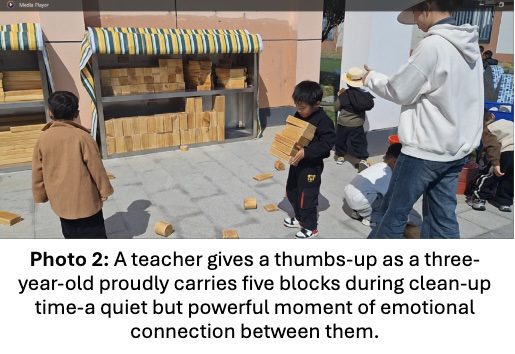
- Building emotional connections. Warm, respectful relationships between teachers and children, and among peers, create a sense of being “seen” and truly understood (see Photo 2).
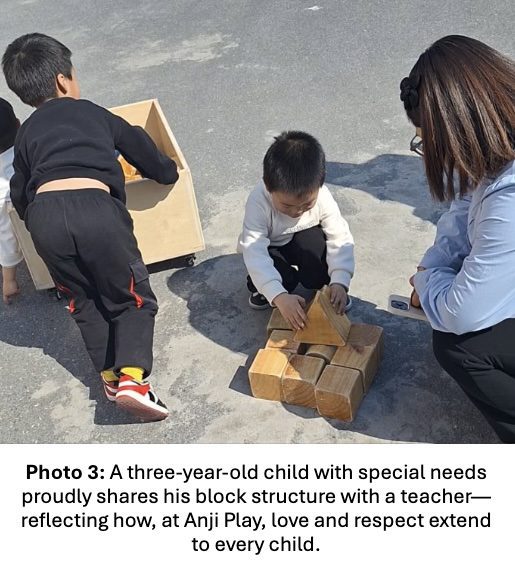
- Embracing every child. Love in Anji Play is not reserved for “easy” or “high-performing” children. It extends to all children, including those with different needs or personalities. Everyone belongs, and everyone matters (see Photo 3).
In Anji Play, love is like the soil or the air—it surrounds everything and makes all other learning possible. It’s not just a philosophy; it’s lived and visible in daily practice.
Engagement.
Anji educators distinguish true play from false one. False play is shaped by adult intentions with educational goals pre-set by teachers rather than children. In contrast, True play is child-initiated, open-ended, and sustained for two full hours every day.
Play materials are intentionally low-structure, moveable, and combinable, allowing endless creative possibilities. Children decide what to use, what to build, how to play, and how long to keep playing—sometimes carrying the same storyline over several days.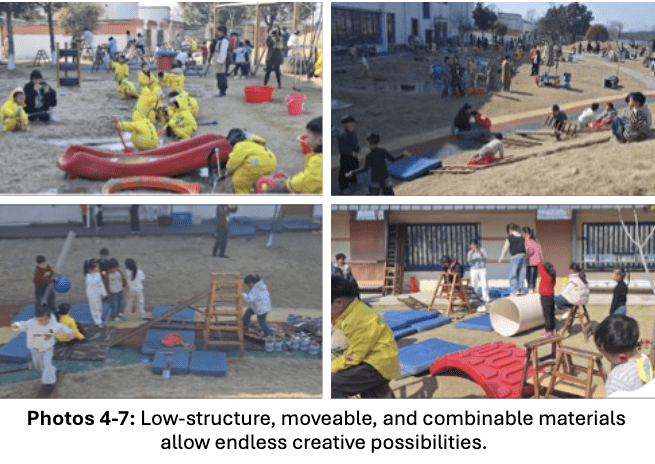
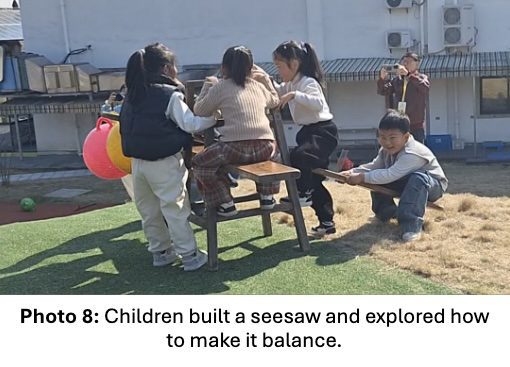
During my visit, I saw a grassy hill with no signage or directions. Children brought mats, ladders, tires, and planks, inventing all kinds of games (see Photos 4, 5, 6, 7). One group even built a seesaw and adjusted the pivot to keep it balanced (see Photo 8). In another corner, four children constructed a large structure, negotiated roles, and solved design problems together.
As I watched the creativity, complexity, and engagement Anji children bring to their play, a famous saying from Vygotsky came to mind: “In play, a child always behaves beyond his average age, above his daily behavior; in play it is as though he were a head taller than himself.” In Anji, this insight feels deeply validated. Children are not only playing; they are growing, reaching, and flourishing.
Risk.
Modern education often prioritizes safety and control at the expense of children’s natural drive to explore. But in Anji, risk is embraced as a vital part of learning. Outdoor spaces offer tiered challenges—like climbing structures of varying heights—so children choose what they’re ready for. Teachers focus on assessing and managing risk rather than eliminating it altogether.
I watched children assemble giant wooden pieces, climb two-meter-high planks, and leap from swings. Yes, it might make adults nervous, but these challenges give children a thrilling sense of mastery and accomplishment. As Anji educators put it: “Children gain the capacity to face life’s uncertainties by facing small challenges now. Deny them that, and they may lose the ability to take charge of their own lives.”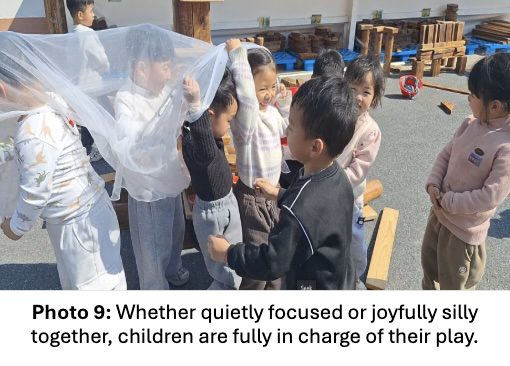
The inherent uncertainty, variability, and novelty of play inevitably bring risks. But it is precisely through these experiences that children learn to assess risks and protect themselves. The rich and authentic experiences that come with such play are unparalleled. Anji Play teaches children that life is full of risks, and that facing them is an essential part of growing up with confidence, courage, and resilience.
Joy.
Joy in Anji Play runs deep, not just surface-level fun, but genuine emotional fulfillment. This joy comes from autonomy, creativity, and the pride of self-expression. With no predetermined rules, children are free to invent, experiment, and problem-solve. In the sand and water area, for instance, one child might sculpt a volcano, while another builds a bridge from sticks.
Anji Play offers a rich variety of open-ended materials and experiences that meet the diverse interests of young children. Whether immersed in quiet concentration, bursting with laughter, or moving together in playful silliness, children fully own their play (see Photos 9, 10). Many Anji kindergartens preserve the natural landscape—hills, trees, mud, and all. Children climb real tree trunks, observe ants relocating their nests, and notice how rain transforms the earth.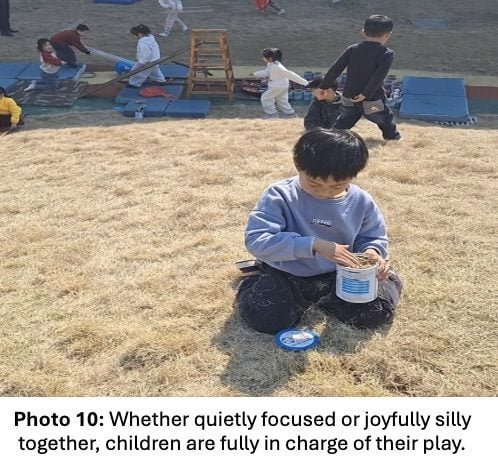
This kind of freedom fuels intrinsic motivation. Children become more curious, creative, and confident. They take pride in what they build and learn resilience through occasional setbacks. In Anji, play is joyful because it belongs to the children. And in that joy, every child finds a path to growth.
Reflection.
Reflection is the final thread that ties Anji Play together, and it’s woven into every day. There are two key structures: Play Sharing and Play Stories.
In Play Sharing, teachers show short video clips of children’s play and invite group discussion. I watched a group of 4- and 5-year-olds analyze why a pink ball kept flying out of a water-swirling pan. They formed hypotheses, debated ideas, and challenged each other’s thinking—all without adult “correcting.” (see Photo 11)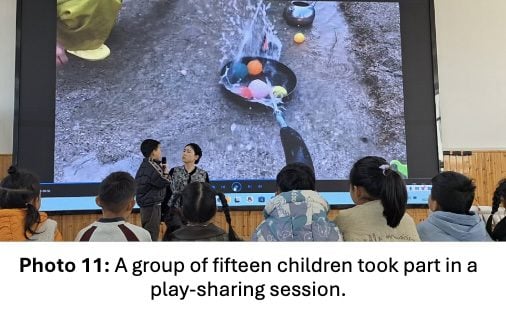
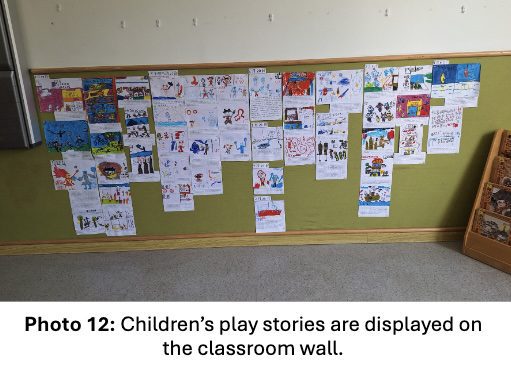
Play Stories follow each play session. Children draw what they experienced and explain it to the teacher, who records their words verbatim. These drawings and narratives are displayed on classroom walls and revisited, helping children reflect on their own learning and progress over time (see Photo 12).
In both practices, teachers don’t instruct. They listen, observe, and support children’s metacognition. Reflection becomes part of the play experience, deepening learning and helping children see themselves as thinkers and problem-solvers.
Final Thoughts.
The five principles of Anji Play—love, engagement, risk, joy, and reflection—are not separate ideas. They work together to create a rich, respectful, and empowering learning environment. This is play as it should be: child-led, emotionally grounded, intellectually alive.
As Ralph Waldo Emerson wrote, “The greatest homage we can pay to truth is to follow it.” Anji Play reminds us: the greatest homage we can pay to children is to trust them. Again, Ms. Chen Xueqin’s words, “True play is every child’s right. True play is true learning. It allows children to return to their nature. Adults rediscover children through true play, and children discover the world through true play.”



Support our work
The Early Math Collaborative works to improve math instruction for young children in three ways:
- Professional development
- Research
- Dissemination