Playing with Math to Build Autonomy, Focus on Understanding, and Increase Joy
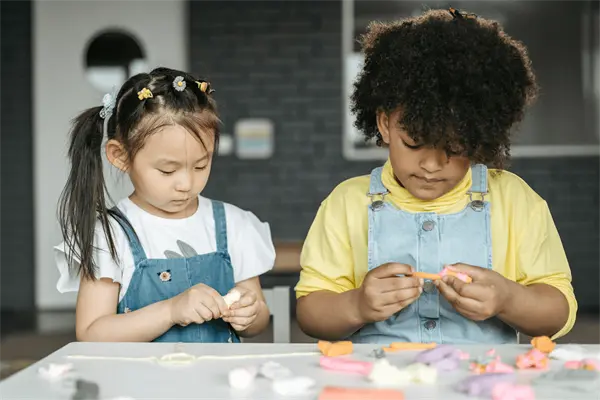
Breanna and Shay are rolling out cylinders of playdough with their hands at the art center. Breanna says, “I’m making a pencil,” and Shay responds, “I’m making a magic wand.” Breanna notes, “If mine is a pencil and yours is a wand, yours should be longer than mine. Make it longer!” Shay rolls her blue playdough back and forth on the table top with increasing pressure. “It’s longer now. But it’s too skinny. I can’t lift it up, it just flops over. I’ll make it thicker.” Shay grabs another handful of playdough, smashes it against her “wand,” and starts rolling again.
As early childhood educators, we all understand how important play is for children’s social-emotional development. It makes sense that children’s language development will also benefit from play. But what about their mathematics?
Shay and Breanna are engaged in some playful math. Ideas of shape, relative size, and the power of adding to increase something are all being explored. They don’t engage in any number talk, but they are deeply immersed in mathematical thinking.
But why might it be useful to make our mathematics more playful? Most math teaching is not playful, so what is the point of changing our approach? There is a strong case for making math teaching and learning as playful as possible across all grade levels, and it starts with thinking how students engage with ideas.
What is “Play?”
Play can mean a lot of things — a soccer game, swinging and singing at the playground, completing a sudoku, a family game of Monopoly, or playing “store” in the housekeeping corner — are all forms of play. Researchers often define play by a set of key characteristics, several of which are particularly relevant to math learning and can help address common challenges in traditional math education.
- Play is generally self-chosen and self-directed.
- In play, the means are more valuable than the ends; that is, process, not product, is the point.
- Play involves an active, alert, involved, but non-stressed frame of mind; in other words, play is joyful.
Let’s explore how each of these characteristics of play supports math learning.
Self-chosen, self-directed
Play is always voluntary. That is, part of what makes play distinct from work is that we actively choose to play, for pleasure. When we play, we choose the rules to which we will hold ourselves. In the scenario above, Breanna and Shay have control over what they are doing — they each choose an object that they will imagine as they roll out their dough.
This sense of autonomy is something math education often lacks. Generally, when children are “doing math,” they are following prescribed procedures. Think of “I do, We do, You do” or imagine a worksheet of math facts — not a lot of room for autonomy. This can prompt children to think they are not “a math person,” and even avoid math tasks as they move through school and life.
Our goal as educators, however, is that children make math their own. We want them to personally identify with math, knowing it is something they can use for their own purposes. Keeping math playful is one way to ensure this sense of autonomy for children, that they “own” the math themselves – and are not just parroting the work of others because they are required to do so, often at the expense of true understanding.
Process over product
Play is also more about the experience itself than any outcomes it produces. When we play, we do so to be in the present moment. There may be goals for our play (think of soccer), but the meaning of the activity is in the experience of the activity itself. While Shay and Breanna are focused on creating imaginary objects, they do not intend to use these objects — the dough will be balled up and put back in the container in a few minutes. They are doing what they are doing because the experience is meaningful.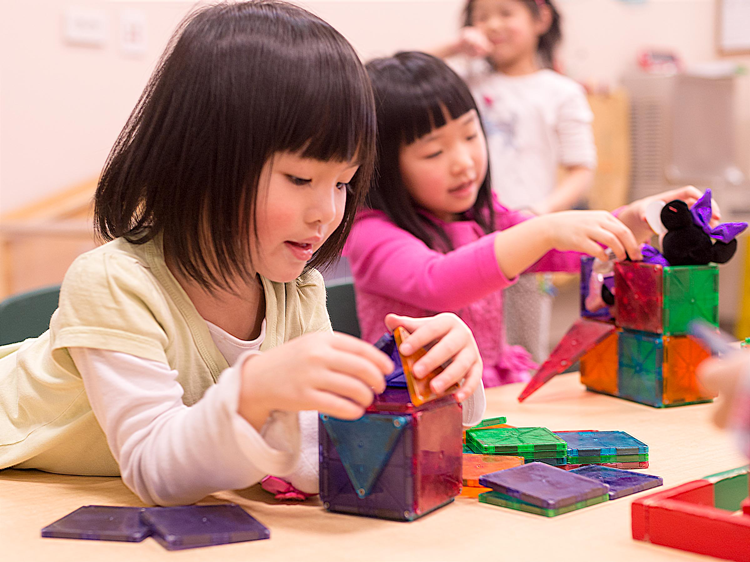
In most math learning experiences, however, the emphasis is on the product. The pressure to achieve the absolute “right” answer makes the math scary rather than pleasant. It misses the most important aspect of learning, which is the thinking and methods we use to get there.
Valuing process over product, however, can be greatly beneficial to math teaching and learning. When teachers have children talk through the different ways they solve a problem, they honor the thinking and understanding behind the answers. Everyone benefits from learning about how their peers worked through their solutions.
Joyfulness
Finally, and most importantly, play is fun. It is literally about pleasure — we participate in it in order to experience joy. Through their play, Breanna and Shay are connecting with one another and with the world as they understand it. They are having pleasant tactile experiences, imagining new things, and thinking creatively. They do these things not because their teacher told them to, but because they enjoy it.
The lack of joy in most math teaching is incredibly damaging to young children. When learning becomes dull, confusing, or burdensome, everyone loses interest. When the pressure to perform is high, anxiety is a natural result. The development of math anxiety is one of the most damaging things that happens in classrooms.
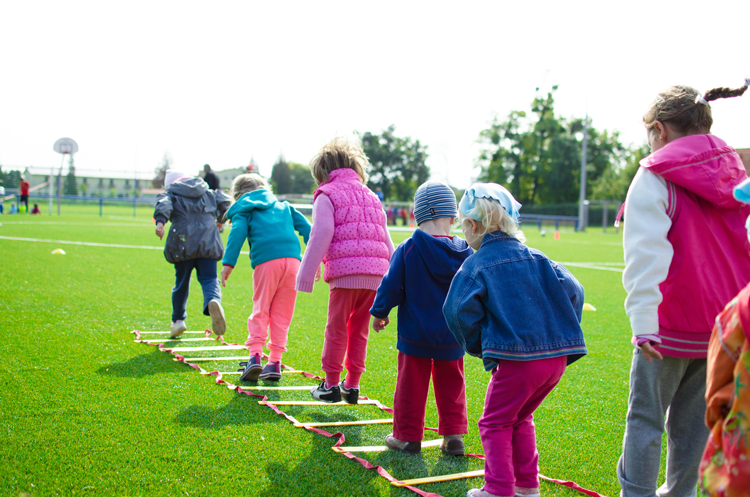
Imagine if more of early math teaching and learning was about fun! It may not be possible to prevent the development of math anxiety in every student, but keeping the math enjoyable seems like a good place to start. When children enjoy an experience, not only do they avoid anxiety related to it, but they learn to seek it out and they bring their best selves to the task. A playful mind is more open to learning than one that is fearful.
In short, keeping math as playful as possible can have enormous benefits for early math learning. Playful math can help emphasize autonomy, provide greater access to the concepts behind the procedures, and defend our learners against the development of math anxiety.


Support our work
The Early Math Collaborative works to improve math instruction for young children in three ways:
- Professional development
- Research
- Dissemination