Attribute: A Building Block for All Mathematics
How are attributes foundational for math thinking?
From birth, humans are hard-wired to notice properties of the world around them and begin sorting and classifying using those properties. Babies can hear in utero, and they can distinguish their mothers’ voices from others at birth. In this case, it is the properties of their mother’s voice: its resonance, its pitch, and its speed, that serve as attributes they use to determine “mother” and “not-mother.”
What is an attribute?
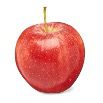 The word attribute refers to the characteristics or qualities that allow us to describe and classify the surrounding world. These qualities are often based on what we observe and perceive with our senses. Attributes are not things themselves but name the traits of things in the world around us. For example, the apple featured in the picture is red and round. We can imagine that if we take a bite, it may be crisp and sweet. These traits—redness, roundness, crispness, and sweetness—are attributes of the apple. We mostly use them to identify and understand what an apple is, but they are also the building blocks for logical-mathematical thinking.
How is this math?
How do these qualities of things help us with math? Consider counting: in order to count the apples in a set of apples and oranges, we must know which ones are the apples, and we use attributes to determine this, as in “Apples are red, have stems, and smooth skin.” To count the Granny Smith apples but not the Gala apples, we agree on rules that determine which are which. Attributes populate these rules and allow us to sort the apples, as in, “Granny Smith apples are green, but Gala apples are red.” Because of the way this rule-making system works, we use attributes every time we identify, categorize, group, and analyze objects, ideas, and even ourselves. Using attribute language, we create sets, and without sets, there is nothing to count!
Development of Attribute Thinking
Preschoolers often have difficulty considering more than one attribute at a time. For example, a three-year-old was shocked to learn that their preschool teacher was also a mother herself, and did not live at the school. This idea, that a person (or an object) can be more than one thing at the same time is difficult for young thinkers to grasp, but opens an entire world of possibilities, including mathematics. This is one reason it is helpful for young children to have many opportunities to sort objects, and especially to sort them in more than one way. Noticing that a pencil is both long and yellow at the same time is powerful knowledge!
As children get older, they begin to think more logically about the world around them. They discover that how something is sorted or classified may depend on what is the focus: that is, if we are sorting groceries by height, the box of cereal might go with the 2-liter bottle of soda, but if we are sorting according to which meals they are for, the box of cereal might accompany the frozen waffles. This is a profound idea: that how we define what something is depends on agreed-upon rules. A child may have dark hair, just like dad, but wear glasses like their sibling—they can be like both family members at the same time, and in different ways.
As children grow and experience more of the world, they become more precise in their understanding; things that were once all called “soft” become fuzzy, mushy, fluffy, or smooth. To develop attribute language, children need lots of adult-supported experience with observation and careful noticing. This “noticing” encourages finding connections, using reasoning, and making sense – valuable skills that support mathematical learning.
Teachers and Family Members Can Help
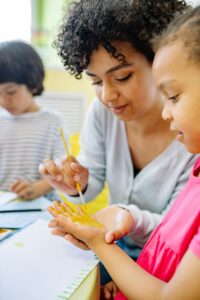 There are many ways that educators and families can play a vital role in supporting children in the development of attribute thinking. For example:
- We can provide environments where children can engage in sensory experiences and help them have robust conversations around attributes. We can ask, “What do you notice?” or “How does it look/sound/taste/feel?”
- We can share our own curiosities and noticings, as in “Our sweaters are both blue, but yours is much darker than mine” and “I wonder whether your sister’s blue sweater is even darker?”
- At first, young children may not have much language to answer these questions, but we can affirm their ideas and layer them with our own descriptive language. When a child sees a Doberman Pinscher and says ,“That’s a big dog,” we can say “Yes, that dog is very tall, but it is also thin.”
Sources:
Where’s the Math?: Books, Games, and Routines to Spark Children’s Thinking by Mary Hynes-Berry and Laura Grandau
Precursor Math Concepts: The Wonder of Mathematical Worlds with Infants and Toddlers by Mary Hynes-Berry, Jie-Qi Chen, and Barbara Abel
Big Ideas of Early Mathematics by The Early Math Collaborative – Erikson Institute



Support our work
The Early Math Collaborative works to improve math instruction for young children in three ways:
- Professional development
- Research
- Dissemination