English Language Learners
Promising Math 2017 was the first in a biennial conference bringing together stakeholders from across the country to share knowledge about the understanding, teaching, and learning of mathematics for children between birth and eight years.
Access to math for young English Language Learners (ELLs)
Our first Promising Math event explored the impact of dual language learning experiences on the construction of mathematical understanding in children from birth to age 8.
Compared to native-English speakers, language-minority children in the United States begin kindergarten with math scores about three-fourths of a standard deviation lower. Among the subset of these children who are not considered “English proficient,” the difference in math scores is a full standard deviation (Galindo, 2010). Given the strong predictive power of math achievement at kindergarten entry for overall school success (Duncan et al., Other), there is great interest in the early math field in developing a better understanding of how these gaps can be addressed.
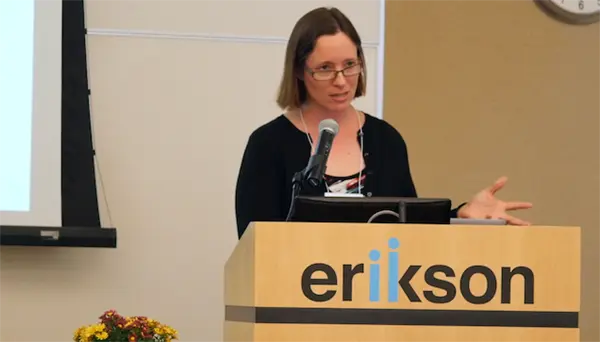
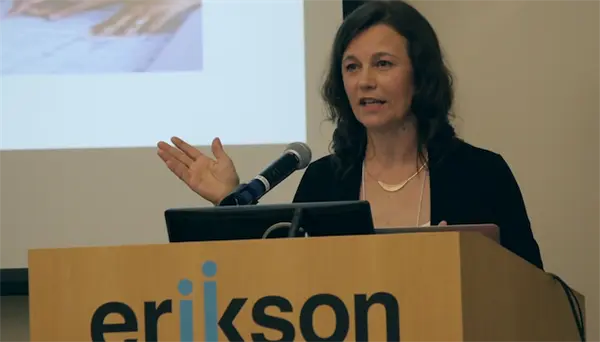
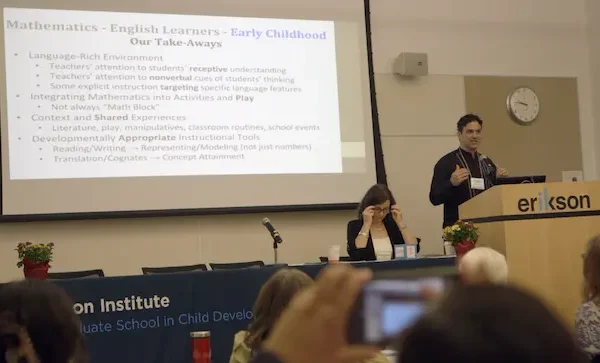
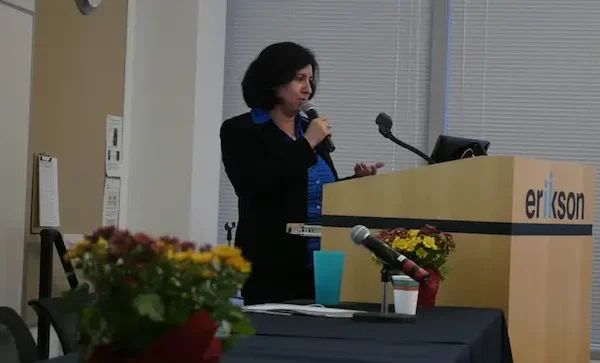
Over 80 professionals from across the country gathered at Erikson Institute in October 2017 to explore the topic.
Explore Highlights from Promising Math
Explore Our ELL Resources

2017 Major Questions
Cognitive
- What difference does learning English as another language in preschool make in the development of very early math concepts?
- How often do children have math knowledge they can express in their home language but not in English?
- How well does the ability to express a solid understanding of early math concepts in a home language transfer to the learning of math symbols and arithmetic in kindergarten and first grade?
Contextual
- What are the most effective non-verbal math representations to help young English learners when math is taught in English?
- Do different approaches to teaching English Language Learners, such as dual immersion, transitional bi-lingual, and English immersion, have differential effects on math learning?
- How does parental engagement in “math talk” in a child’s home language relate to her ability to learn about math in English?
Collaborative
- How can we better prepare teachers of young children to teach math to children whose home language is not English?
- What can we do to help non-English-speaking parents help their children to learn mathematics?
- How should math professional development be tailored to meet the needs of teachers’ aides and assistants, who are sometimes the only adults in the classroom who speak the child’s home language?
Plenary Speakers

Sylvia Celedón-Pattichis
Interim Senior Associate Dean for Collaborative Research and Community Engagement
Professor of Bilingual/Mathematics Education
University of New Mexico
Plenary Topic: Opportunities to Learn High Quality Mathematics in Bilingual Kindergarten and First Grade Classrooms
Silvia Celedón-Pattichis studies linguistic and cultural influences on the teaching and learning of mathematics, especially with emergent bilinguals. She was Co-PI of the Center for the Mathematics Education of Latinos/as (CEMELA), an NSF-funded collaboration among four universities. CEMELA worked to develop theory and practice around turning language and cultural diversity into educational assets for the mathematics education of all students. Her most recent work is a co-edited book in press by the National Council of Teachers of Mathematics (NCTM) titled Access and Equity: Promoting High Quality Mathematics in Grades PreK-2 and another book in the same series for Grades 3-5. She is a co-editor of Beyond Good Teaching: Advancing Mathematics Education for ELLs, also published by NCTM in 2012. She also co-authored a recent article in Cultural Studies of Science Education entitled “An interdisciplinary collaboration between computer engineering and mathematics / bilingual education to develop a curriculum for underrepresented middle school students.” Dr. Celedón-Pattichis is also the co-editor of Mathematics Education at Highly Effective Schools that Serve the Poor: Strategies for Change, published by Lawrence Erlbaum in 2006.

Barbara Sarnecka
Associate Professor of Cognitive Sciences
University of California at Irvine
Plenary Topic: The Real Preschoolers of Orange County: Early Number Knowledge Among Dual-Language Learners from Low-SES Households
Barbara Sarnecka studies cognitive development, especially the question of how children learn about counting and numbers during the preschool years. She also works on social cognitive development, the development of judgment and decision-making, the development of self-efficacy and autonomy, and adult moral psychology. Barbara is currently working on a book about scientific writing, using insights from cognitive science and linguistics to help scientists write better. She is the author of “How numbers are like the earth (and unlike faces, loitering or knitting)” in Core Knowledge and Conceptual Change (2016) and also of an upcoming chapter in Language and Culture in Mathematical Cognition: “Early Number Knowledge In Dual-Language Learners From Low-SES Households.”

Rodrigo Gutiérrez
Co-Director of the Center for Recruitment and Retention of Mathematics Teachers (CRR)
University of Arizona
Plenary Topic (Co-host): Integrating Language and Mathematics: Principles and Tools for Elementary Teachers and Students
Rodrigo Gutiérrez’s professional interests include teacher development, mathematics education, and teaching for social justice, with a particular emphasis on Latinx and emergent bilinguals. He has broad experience designing and implementing professional development to assist teachers in making their instruction more appropriate for new immigrants. After teaching middle and high school mathematics, Rodrigo directed an educational non-profit running afterschool and summer programs for underserved youth of color. Having previously been a fellow with the Center for the Mathematics Education of Latinos/as (CEMELA), Rodrigo recently returned to the University of Arizona to serve as Co-Director of the Center for Recruitment and Retention of Mathematics Teachers.

Galiz (Halla) Jmourko
ESOL Instructional Coach
Prince George County Public Schools in Maryland
Plenary Topic (Co-host): Integrating Language and Mathematics: Principles and Tools for Elementary Teachers and Students
Halla Jmourko is an ESOL (English for Speakers of Other Languages) instructional coach in Prince George’s County Public Schools, MD. Halla’s primary professional engagements are focused on advocacy for children coming from diverse cultural and linguistic backgrounds. What began as a personal experience as a parent of a dual language learner became a professional investigation about the role of language in mathematics learning and a commitment to supporting English learners (ELs) in mathematics. She designs professional development opportunities, creates language-based instructional tools, and implements a variety of coaching structures to support mainstream and ESOL teachers of English learners across content areas, but particularly in mathematics. Over the years, Halla has been working with Center for Mathematics Education, University of Maryland to support university-district outreach efforts and is currently co-teaching a course on middle school mathematics instruction for ELs.
Sponsors
The conference is generously funded by a grant from the CME Group Foundation and the Heising-Simons Foundation.


Big Ideas of Early Mathematics
What Teachers of Young Children Need to Know
The Big Ideas that convey the core concepts of mathematics are at the heart of this book that gives early childhood educators the skills they need to organize for mathematics teaching and learning during the early years.
A Library of Ideas
Browse hundreds of articles, videos, modules, and discussions in our Idea Library we have collected, categorized, and curated the best resources for early math thinking and teaching.

Join the Collaborative
Together, We Can Change the Way Math Is Taught
Join a hub of educators, administrators, and professionals reframing the way we think about and teach math.