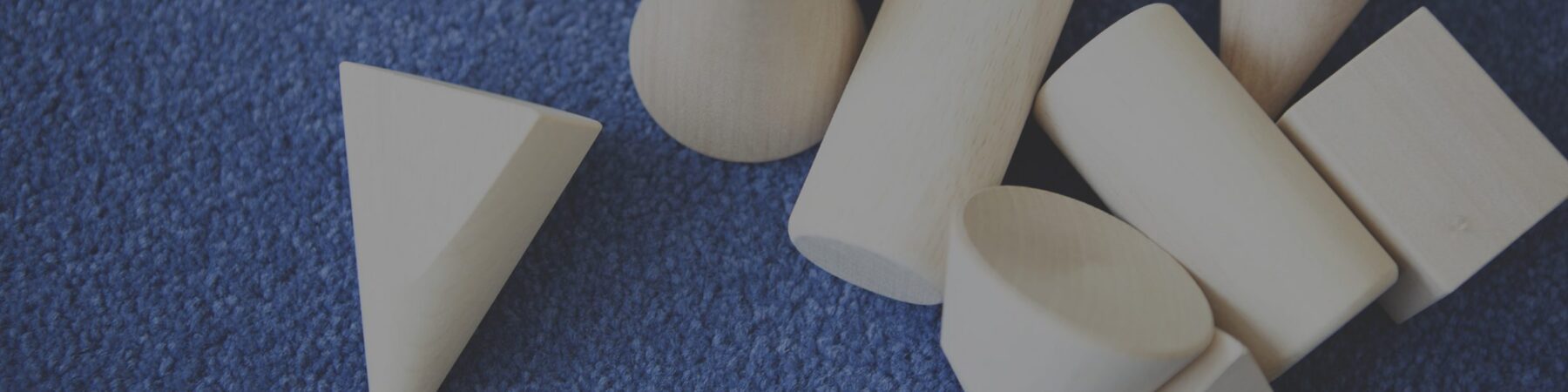
Big Ideas of Shapes
Learn the big ideas of shapes, and explore related activities, books, and resources.
Understanding Shapes
Everything in the material world has shape. A deeper knowledge about how two- and three-dimensional shapes are defined and relate to one another will help educators be aware of subtle distinctions and rules. Such an understanding allows educators to notice and highlight children’s key discoveries and to guide their experiences to make this knowledge explicit for them.
Copyright: Erikson Institute’s Early Math Collaborative. Reprinted from Big Ideas of Early Mathematics: What Teachers of Young Children Need to Know (2014), Pearson Education.

Shapes can be combined and separated (composed and decomposed) to make new shapes
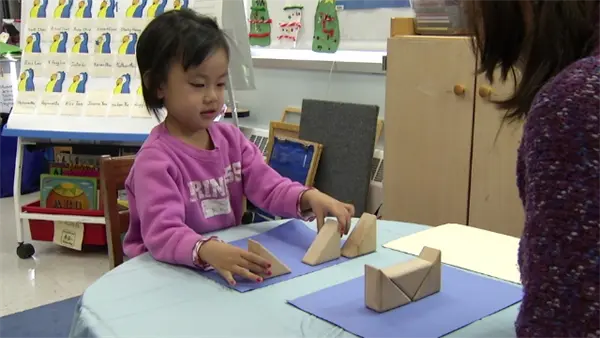
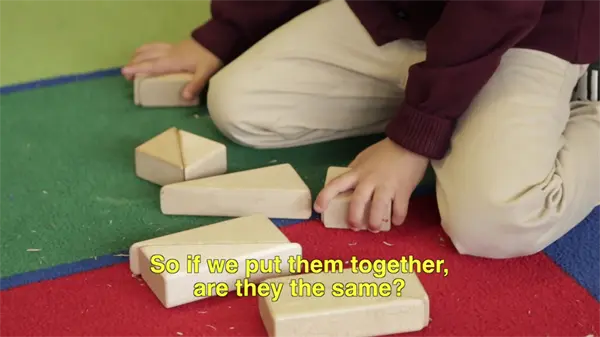
Opportunities to combine, rotate, and compare shapes will help children develop understanding of part-whole relationships within and among shapes (as when two identical right triangles are combined to make a rectangle).
The flat faces of solid (three-dimensional) shapes are two-dimensional shapes
As they explore three-dimensional solids, children will discover for themselves that the faces (or sides) of these solids look like circles, rectangles, triangles and other common two-dimensional shapes.
Shapes can be defined and classified according to their attributes
Children need to go beyond the use of superficial shape labels to recognizing and specifying the defining attributes of shapes. As children sort and classify shapes with knowledgeable others, they become aware of rules about shapes, such as that a triangle has three sides and three angles (corners), that a cylinder has a rounded form with two flat ends that are in the shape of a circle, or that a sphere has only one continuous curved side. That these sorts of precise distinctions can be made is not immediately obvious to young children; for this reason, it is important that teachers design activities to demonstrate this.
Explore Books & Resources Related to Shapes
Everything in the material world has shape. However, in mathematics, the focus is very much on regular shapes, such as the two-dimensional circle, triangle, and rectangle (including everyone’s favorite rectangle, the square) and the three-dimensional solids known as spheres and polyhedrons (that is, geometric solids with flat faces and straight edges).
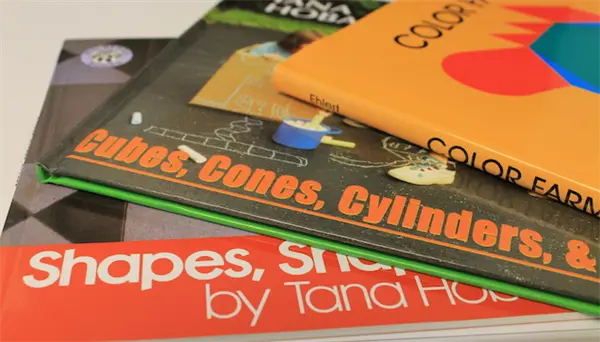
In our everyday world, these solids commonly appear in objects we describe as boxes, pyramids, blocks, cylinders, and balls. Children in a math-rich early childhood environment will have many experiences working with shape, and the books they interact with can help further discussions, helping them to think deeper about the attributes of different shapes.





Big Ideas of Early Mathematics
What Teachers of Young Children Need to Know
The Big Ideas that convey the core concepts of mathematics are at the heart of this book that gives early childhood educators the skills they need to organize for mathematics teaching and learning during the early years.

Join the Collaborative
Together, We Can Change the Way Math Is Taught
Join a hub of educators, administrators, and professionals reframing the way we think about and teach math.