Rooted in Community: Chicago’s Little Village
Planting community relationships for school-based mental health
Nervous giggles broke out in the circle of community public health workers when Francisco J. Lozornio, DSW, LCSW, reached into a bag, tossed out two invisible “magic balls,” and told the group, in Spanish and English, that it was time to play.
Lozornio pretended to kick, juggle, and bounce a ball, and the group quickly joined in. Joyful laughter rang through the sunny meeting room at Enlace, a community-based health organization headquartered on a quiet residential block not far from the bustle of 26th street’s Latine business corridor in Chicago’s Little Village neighborhood.
The workers, or Promotorxs de Salud, are community leaders that Enlace trains and employs to serve as liaisons between Little Village residents and health providers. Promotorxs understand the culture and traditions of the community and use their knowledge to address concerns and support people’s engagement with needed resources. On this day, they were participating in professional development focused on mental health.
The “magic ball” activity is one of the exercises that Lozornio, an assistant professor in Erikson Institute’s Master of Social Work (MSW) program, uses to demonstrate the stress-relieving power of visualization and play.
Starting in January of 2025, he has conducted dozens of community conversations and skill-building training sessions in Little Village to lay the groundwork for a reimagined approach to Erikson’s school-based mental health program that will resume in several elementary schools this autumn. The goal is to nurture children’s emotional and developmental well-being by helping families and schools work together through a culturally responsive, community-embedded model.
“Before we even enter the schools, I wanted to build trust and learn from the stakeholders who are already working with the families we hope to reach,” Lozornio said. “My previous work in violence prevention resulted in strong relationships that have provided a foundation for the new work that Erikson is doing.”
Because of his existing relationships in Little Village, Lozornio was able to move quickly to recruit members for a community advisory committee to guide the school-based mental health project.
The ROOTS initiative
Lozornio joined Erikson less than a year ago, but he is already making long-term impact. Together with Little Village leaders, he has co-created a multi-tiered system of support for children’s mental health called “ROOTS” (Restoring Opportunities & Overcoming Trauma Systematically). The ROOTS framework embodies interdependence, collective strength, and holistic care. It seeks to leverage family strengths and cultural wisdom, and to empower the community itself to drive systemic change.
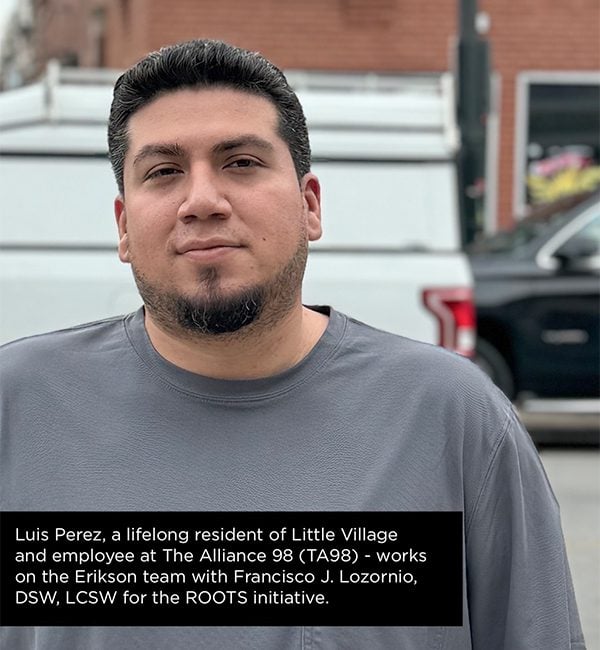
Tapping into community wisdom, Luis Perez, a lifelong resident of Little Village and employee at The Alliance 98 (TA98)— a social enterprise organization focused on youth and young adults— was brought on as project manager for the ROOTS initiative.
Perez described how ROOTS is based on an agricultural model known as “The Three Sisters,” an ancient practice by many Native American tribes, particularly in North America. This method involves growing corn, beans and squash together to promote a thriving planting system.
“The community represents corn, the people, culture, and local support that hold everything together,” Perez said. “Like corn supports the beans, a strong community supports everyone else. Nonprofit organizations are the beans. These groups provide service and resources like mental health support and parenting classes that give back to the community, like beans enrich the soil. Community schools are the squash. Schools protect and support kids, like the squash covers the ground and protects the plants. They help children learn and grow, support from both the community and nonprofits.”
ROOTS takes a holistic approach to mental health and acknowledges that children’s lives continue beyond the classroom—they rely on family, neighbors, and organizations to thrive. The model ensures a child’s entire community supports them, within and outside the walls of the school.
Growing more clinicians
Erikson is moving outside its own walls in many ways as the institute launches new strategic objectives informed by the changing needs of graduate students and the early childhood field. Lozornio’s work in Little Village is one of the clearest examples of this new direction.
Despite long-held assumptions about cultural stigma in the Latine community around seeking mental health help, there is a significant demand for services. However, bilingual and bicultural Latine mental health practitioners are scarce, leading to long wait lists and delays in receiving services.
Erikson is making strides to close that gap. A key component of the institute’s school-based mental health program is to build a career pathway that will increase the number of bilingual and bicultural mental health professionals serving the community. Erikson is doing this by using scholarship funding and other support specifically for Little Village residents.
It’s an approach that is already producing results. Perez was accepted into Erikson’s MSW program and will begin this fall.
When asked what difference the ROOTS model will make a year from now in Little Village, Perez harkened back to the “three sisters.”
“I think what would look different, and I hope what would look different, is that children get to grow just as healthy as those vegetables get to grow,” he said.
To hear more about Erikson’s work in Little Village, please view this video featuring Perez.
Rooted in Community: Little Village Video
Join the Erikson family with monthly news + events updates shared by academics, community members, and families.



Create a Better Future For Children While Building Yours
Embark on your early childhood graduate program path at Erikson Institute and start changing lives.